Showing posts with label fruit. Show all posts

Wednesday, February 27, 2008

grapefruit cake with honey cream


What a week.

It's been the week of disappointing desserts in my kitchen. I won't fill you in on all the details, but just picture curdled eggs in custards, and seized-up chocolate batters. I really needed something comforting to turn to, and that for me is soft, spongy chiffon cakes. Lucky for me, as when I opened up my issue of Gourmet this week, I saw a recipe for Meyer Lemon Cake with Lavendar Cream. Well, I had neither Meyer lemons nor lavendar on hand, but I did have a nice big grapefruit and a delicious jar of honey that I picked up from work. So I gave it a go.

And wouldn't you know, it looked nothing like the picture in the magazine. It didn't rise up very well into a nice poofy domed shape. Instead, it came out looking like a torte. (Next time, I will use a smaller than a 9" springform pan.) The taste-test, however, reaffirmed my faith in magazine recipes. Like a chiffon cake, it was light and spongy. The generous portion of olive oil in the batter added a nice richness that balanced out the tang of the lemon curd. My honey pastry cream was runnier than I'd like, probably because I hadn't chilled it long enough.


All in all, it was a gorgeously rustic cake, with delicious citrus flavors. I can't complain. I got to have my cake and eat it too.


Grapefruit Cake with Honey Cream
adapted from Gourmet, March 2008
serves 8


CAKE:
5 large eggs, separated
3/4 cup sugar, divided
3/4 cup extra virgin olive oil
1 Tbsp grated grapefruit zest
1/4 cup fresh squeezed grapefruit juice
1 cup cake flour
1/2 tsp salt

LEMON CURD:
1/2 cup plus 1 Tbsp sugar
3 Tbsp flour
1/2 tsp salt
1 tsp lemon zest
3/4 cup lemon juice
1 large egg yolk
1 Tbsp unsalted butter

HONEY PASTRY CREAM:
1 cup whole milk
6 Tbsp honey
3 egg yolks
2 heaping Tbsp corn starch
pinch salt
2 Tbsp unsalted butter

1. Cake: Preheat oven to 325F. Line the bottom of a 9" springform pan with parchment paper. Butter the paper and the sides of the pan. Set aside.

2. Beat together egg yolks with 1/2 cup sugar until pale and thick, about 3 minutes. At medium speed, beat in oil, and grapefruit zest and juice until just combined. Sift in flour and mix at low speed until just combined.

3. Beat whites in another bowl until foamy, and add in the remaining 1/4 cup sugar a little at a time. Beat until whites just hold soft peaks. Fold in 1/3 of whites into the yolk mixture to lighten, then fold in remaining whites gently. Transfer batter to the prepared pan, and bake 40-45 minutes until golden brown. Remove, cool for 10 minutes, release the sides, and let come to room temperature.

4. Lemon Curd: Whisk together sugar, flour, and salt in a small heavy saucepan, then add lemon juice in a slow stream, whisking until combined. Bring to a boil, whisking constantly, then simmer, whisking, until thickened, about 3 minutes. Remove from heat.

5. Whisk yolk in a small bowl, then add about one fourth of lemon-juice mixture, whisking vigorously. Whisk into remaining lemon-juice mixture and gently boil, whisking, 1 minute. Remove from heat and stir in butter and zest. Transfer filling to a bowl and cover surface with buttered parchment paper. Chill until cool, at least 30 minutes.

6. Pastry cream: Heat milk and honey in a heavy saucepan over medium heat, stirring to dissolve the honey, until almost simmering.

7. In a bowl, whisk the egg yolks with the corn starch and pinch of salt until the mixture is pale yellow and thick. Spoon some of the hot milk mixture into the egg yolks while whisking to temper the egg yolks. When blended, pour this back into the saucepan, constantly whisking. Continue stirring over low heat for another minute, and stir in the butter, one tablespoon at a time.

8. Strain the cream into a bowl to remove any lumps. Cover the cream with a piece of plastic wrap pressed directly onto the surface (to prevent a skin from forming) and chill for at least 4 hours.

9. Assembling: Cut the cake horizontally into 2 even layers (3 if your cake is tall enough). Spread a thin layer of lemon curd on the first layer, leaving a 1/2" border around the edge. Spread a thicker layer of pastry cream over this. Top with the next cake layer. (Repeat if necessary, for 3 layer cake.) Press down gently so that the fillings can spread out to the edges. Dust with powdered sugar.

Tuesday, February 19, 2008

flourless chocolate pear torte


Second to a chocolate bar, flourless chocolate cake is the next best way of delivering the highest percentage of chocolate (with the best chocolate to weight ratio) straight to your veins. Who needs all that starchy filler they call flour? Surely not me. Give me this dense, calorie-laden dessert. A girl like me doesn't need much.


The pear? Well, that was on a whimsy. They were originally supposed to have been caramelized bananas, but alas, there were none to be found on hand. Which was all for the better, because pear and chocolate are like two long lost lovers. Their flavors marry well together, with the fragrant pear perfectly complementing the deep earthiness of the chocolate. Pear works well with white chocolate also, but that's not really chocolate now, is it?

Just because it's past Valentine's Day doesn't mean we should lessen our chocolate intake. There's a reason to eat it everyday; hey, dark chocolate has been scientifically proven to be really good for our health. And our sanity.


a base layer of delicious seasonal pears


Flourless Chocolate Pear Torte

yields a 9" torte

Use a high quality bittersweet chocolate, or else it's really not worth making at all. I prefer Bosc pears; they have a much cleaner, sweeter taste. The powdered sugar decoration is purely optional. You can create the same effect by cutting out shapes in parchment, laying them over the cooled torte, and generously sprinkling the sugar over it.

10 oz. sugar
12 oz. bittersweet chocolate, roughly chopped
6 eggs
2 3/4 sticks unsalted butter, cut into 1" pieces
2 Tbsp espresso, or brandy (optional)
1 pear, peeled and cored
1 tsp ground cinnamon
powdered sugar, for decorating

1. Preheat oven to 350F. Line the bottom of a 9" springform pan with parchment paper. Butter the sides, and wrap 2 layers of foil around the outside of the pan, in preparation for the water bath. Set in the middle of a large roasting pan.

2. Whip the eggs until they double in volume, about 5 minutes. Set aside.

3. In a double boiler, melt the chocolate. When it is completely melted down, stir in the sugar and butter. Continue melting until you obtain a smooth, lustrous consistency. Remove from heat. Stir in the espresso or brandy.

4. Slice the pear, vertically, into 12 pieces. Lay them in a circle at the bottom of the prepared springform pan. Sprinkle evenly with ground cinnamon.

5. Gently fold the whipped eggs into the melted chocolate mixture, in 3 steps. Be sure the batter is well blended. Pour over the pears, into the pan. Pour enough boiling water into the roasting pan, so that the water comes up halfway up the sides of the springform pan.

6. Bake for 35-40 minutes, until the top of the torte is set, but still slightly wobbly. Remove from the oven and cool to room temperature. Cover and chill in the refrigerator overnight. Loosen the torte from the pan, invert to remove the parchment paper, and reinvert onto a serving dish. Decorate as needed.

Sunday, February 10, 2008

jewish apple cake


The first time I'd heard of Jewish apple cake was when I had first started dating Mr.S, I'd asked him what his favorite cake was. Being born and bred in Baltimore, he told me "Jewish apple cake, of course," followed by all sorts of drooling noises and eyes rolling back into his head. As I'd soon discover, like Scrapple, this cake is a regional favorite, being quite popular in bakehouses all over Philadelphia to here in Baltimore. It's an incredibly moist bundt cake, filled and topped with a layer of cinnamon-dusted apple slices. Once I got a whif of this cake, I could easily understand Mr.S's reaction of unrestrained excitement.

So how and why is it Jewish? No one is exactly certain surrounding the origins of the cake (except that it is most likely from Eastern Europe), but it's very similar to an apple cake that's served during Rosh Hashanah. Moreover, the recipe is completely dairy-free, calling for vegetable oil instead of butter, and orange juice instead of milk. Overall, it's a guaranteed fool-proof recipe that will turn out some of the best apple cake you'll ever have. The orange juice flavors the cake with a fragrance that's not tart like lemon, but much sweeter, which accents the apples perfectly. What's more, the apples keep the cake super moist for days.


I bake a huge 10" bundt cake every year now for Mr.S's birthday. I'm sure the recipe can be broken down into smaller amounts for individual Jewish apple cakes (great or gift giving) and cupcakes. Whole Foods sells a small 6" one which I've never tried, because they always look slightly smushed and bruised from the packaging. Besides, why spend $7 on a cake you can so easily bake at home, with ingredients you probably already have in your pantry? (If anyone knows of a local bakery that offers mind-blowing Jewish apple cake, please drop me a line.)

Jewish Apple Cake
makes one 10" bundt cake

CAKE:
3 cups flour
2 1/2 cups sugar
3 tsp baking powder
1 tsp salt
4 eggs
1 cup vegetable oil
1/2 cup orange juice
1 Tbsp vanilla extract
1/2 tsp cinnamon

APPLES:
3 apples, peeled, cored and sliced
3 Tbsp sugar
2 tsp cinnamon

1. Preheat oven to 350F. Grease and flour a 10" bundt pan.

2. In a large bowl, gently toss together the apple slices with the 3 Tbsp of sugar and 2 tsp of cinnamon. Set aside.

3. In a mixer bowl, combine all the cake ingredients and beat until well blended, about 1 minute. Pour half the batter into the prepared pan. Arrange half the apples in a layer over the batter. Pour the rest of the batter into the pan to cover the apples. Finish off by arranging the remaining apples in a layer on top.

4. Bake for 1 hour 15 minutes or until the cake turns golden brown. A knife inserted in the center should come out clean. Let cake cool in the pan. Run a knife around the edges to loosen the cake and gently invert out onto a plate. Re-invert onto a serving dish. Dust with powdered sugar.

Friday, November 30, 2007

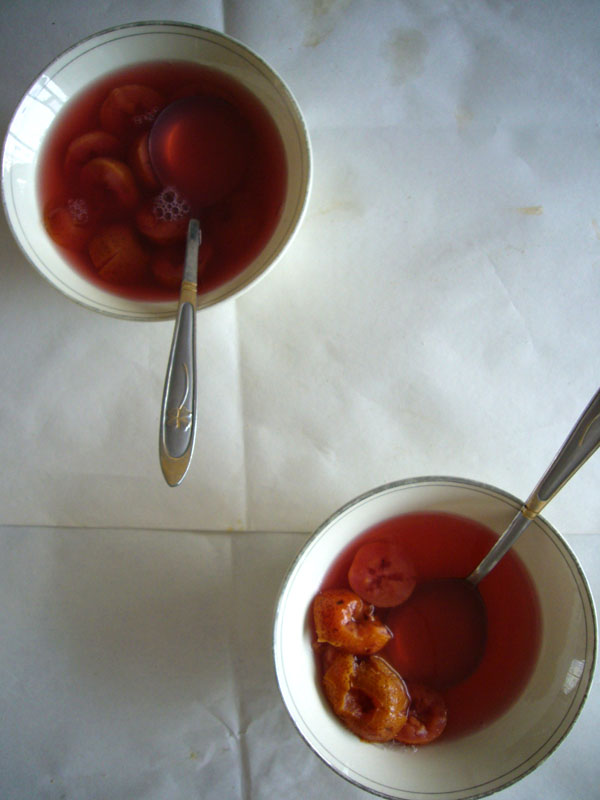
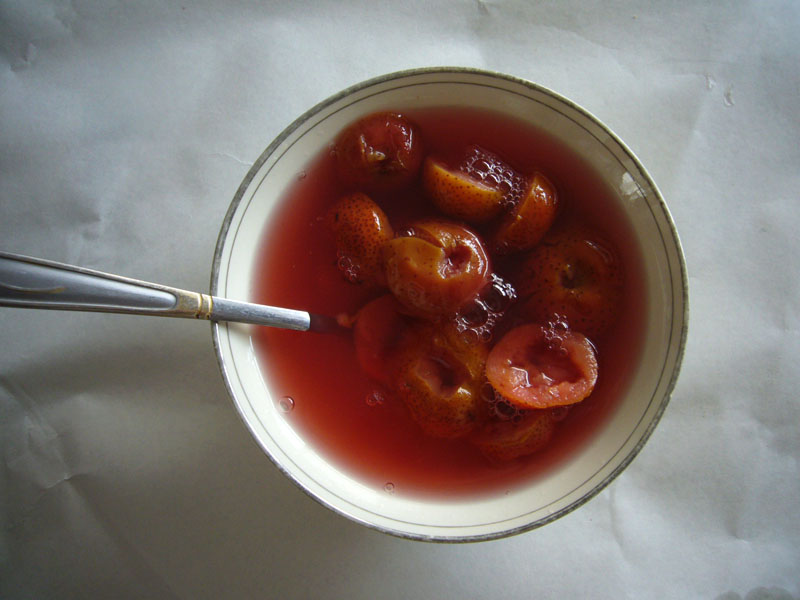
hawthorn soup

What the heck are hawthorns? You may be wondering. Sounds like it could be a grass or the relative of an herb. Well, it's actually a small fruit, much like a crabapple, prevalent in northern China. Lightly sweet, but mostly mouth-puckeringly tart, these little babies come into their own during the winter season. They're sold as street food, in the form of skewers of candied fruit (called tang hu lu). These were one of my favorite things to eat as a little one, bundled up in sweaters, coats, and hats, sucking on a hawthorn on a stick. Oh the memories.

Tang hu lu

Hawthorn are also used in medicines and tonics to aid digestion, probably due to its high acidity. In terms of other snacks, its juices and pulp are made into a block of jelly, reminiscent of guava jelly. Another are hawthorn flakes, small round flake candies, almost like fruity communion wafers.

My grandfather and I hauled ourselves, ironically, over to the Walmart (in Changchun, China) to do a bit of hawthorn shopping. Amongst the rows of exotic fruits, chives and wild greens, tubers and fresh nuts, we spotted the little darlings, all hard and deeply red, fresh still with branches and leaves intact. We brought home about two kilos, ready to make my grandfather's famous hawthorn soup. It's like a dessert, served chilled, and after dinner to help with digestion. After his daily afternoon nap, we set out to work seeding about a bit more than one kilo of hawthorn. In non-metric speak, that’s almost three pounds. These are some of my favorite times with him, when he teaches me techniques and old recipes. No secrets here. We chat and drink tea, and even the silences are oddly comforting. Soon my grandmother comes out to join us from her nap, sneaking a hawthorn when we’re both not looking, her face puckering guiltily afterward from the sour fruit. We let the hawthorn cook and cool on the windowsill, as it’s a blustery 2 degrees Celsius outside.


After our dinner of smoked duck, congee, and steamed crabs, my grandfather filled up bowls of the cool, syrupy soup. Sweet, tangy, and simply light, what a refreshing palate cleanser after a heavy meal.

Since hawthorns are not readily available in the States, cranberries would be a great substitute for this recipe. But if you ever do find yourself walking around Beijing or any northern city mid-winter, do try a sugary skewer of hawthorns. It’ll make your mouth pucker and your heart warm.

Hawthorn Soup

1 pound hawthorn
1-2 quarts water

3/4 cup sugar
2 Tbsp honey

1. Wash and stem the hawthorn. Make a horizontal slice around the midsection of the fruit, and gently pry open with your fingers. Use the tip of a paring knife to carefully pull out the seeds. Repeat with the remaining fruit.

2. In a large stockpot, bring the water to a boil (use 2 quarts if you prefer a more watery soup). Add the hawthorn and sugar, and simmer for 25-30 minutes. Turn the heat off, and stir in honey.

3. Let come to room temperature and chill until completely cooled. Serve cold.

Friday, October 26, 2007

eve's pudding


The Anglophile in me is truly drawn to the simplicity and robustness of British dishes. No room for light mousses nor decadent ganaches, Brit desserts are stick-to-your-ribs, no nonsense creations, yet elegant in their own right. They'd be like the elephants of the dessert kingdom, staunch and reliable, well-built and heavy, and regal and graceful all at the same time. Very rarely do you find a recipe that calls for more than a handful of ingredients or for some esoteric method of preparation.

Eve's Pudding is aptly named after Eve and the apple from the tree of knowledge, mostly for its desirable qualities. Sweet apples are topped with a traditional Victorian sponge cake. Since the sponge acts as a crust, the apples cook by steam, yielding a brilliantly tender layer of stewed fruit, then a creamy light vanilla cake.


We associate puddings with sticky, wobbly, and creamy things, but when the Brits speak of pudding, they're referring to a large array of desserts, mostly cakey things that are steamed or baked. Dense and buttery, these puddings vary with the seasons, capitalizing on the freshest and best fruits of each, whether it be berries for a summer pudding or charlotte, prunes in a sticky toffee pudding, or candied fruits and peels in a Christmas pudding.

This recipe is easy and delicious, and must be eaten all in one sitting. That's an order. (Its texture is wet and creamy, thus keeping it longer for more than two days is probably a bad idea.) It can be done, really.


Eve's Pudding

Sponge Cake:
1 1/4 cup flour
1 1/4 tsp baking powder
pinch salt
1/2 cup unsalted butter, at room temperature
6 Tbsp sugar
2 eggs
1/2 tsp vanilla extract

3 apples, peeled and cored
1/4 cup sugar
1 Tbsp lemon juice
1/2 tsp cinnamon
pinch salt

1. Slice apples into thin 1/8" slices. Gently toss with 1/4 cup sugar, lemon juice, and cinnamon. Set aside.


2. Preheat oven to 350F. Whisk together flour, baking powder and salt. In another bowl, cream together butter and sugar with a mixer until it becomes smooth and pale. Add the eggs, one at a time. Alternately add in the milk and flour mixture. Do not over beat.

3. Spoon reserved apples into single-serving ramekins or souffle pans (48 oz), about 3/4 of the way full. Pour any remaining juices over the apples.


4. Spoon batter over the apples and with a flat spatula, level out the batter to form a flat seal to cover the fruit. Sprinkle the top with sugar.


5. Bake for 45 minutes. Serve warm with whipped cream.

Wednesday, October 24, 2007

french apple tart


Yesterday was my dad's birthday. I won't broadcast his age, but I can say that he still looks like a vibrant 45, with the athleticism of a 30-something year old. I hope those good genes run the family! He and my mom have logged almost 250 miles hiking this year! We went out to one of his favorite restaurants, Sweet Water Tavern, an upscale brewery that serves up eclectic southwestern dishes with a flair. We skipped dessert there, since I made everyone a special tart from all the apples that are sitting in the fridge from my apple-picking foray.

This is a recipe that produces a thin and buttery, lightly sweetened tart. It's not the best way to use up a lot of apples, definitely the opposite of a mile-high American apple pie. But it is a beautiful sight to behold, and so ethereally light on the palate.

We sat around the kitchen island, drinking tea and eating dessert, as we caught up on everything that happened this past week. It's been hellishly busy (hence why I have been blog-absent for the past week) with me logging many long distance miles on my car, attending a wedding, working on applications, tutoring, and planning my upcoming trip to China next week. So much to do, so little time to cook! It did calm me to get back in the kitchen to make this tart, peeling and slicing the apples, making the pastry...all so methodical and soothing for me. Kitchen therapy. Let's all try it.


French Apple Tart
adapted from Le Cordon Bleu Dessert Techniques

Pâte Sucrée:
1 2/3 cups all-purpose flour
1/4 sugar
3/4 cup unsalted butter, chilled (1 1/2 sticks)
2 egg yolks
pinch salt

3 baking apples (Granny Smith, Cameo, etc)
2 Tbsp melted butter, for brushing
1/8 cup sugar, for sprinkling

apricot jelly, for glaze

1. For the pastry dough: Mix together flour, sugar and salt. Cut the butter into small cubes and add to the dry mixture. With a pastry cutter, cut the butter into the flour, until it is evenly incorporated and the size of the small peas throughout. Make a well in the center of the mixture, add the yolks, and use your hands to work into a crumbly dough. Form into a ball, cover with plastic wrap, and refrigerate for 30 minutes.

2. Meanwhile, peel and core the apples. Cut into thin slices, about 1/8" thick. Toss with a few drops of lemon juice to stop them from browning.

3. Preheat the oven to 375F.

4. Roll out the dough between 2 sheets of plastic wrap or wax paper. Drape over the tart pan, gently press into the fluted sides, and trim the excess dough off the rims. Arrange the apples in a circular pattern in the tart. Brush with the melted butter and sprinkle on the reserved sugar. Bake for 45 minutes, or until golden.

5. Let tart cool completely to room temperature. Melt the apricot jelly with a bit of water in the microwave. Brush over the apples for a sweet glaze, and let it cool to set up. Cut and serve.

Wednesday, October 17, 2007

whole wheat banana walnut bread

Not another teen movie! What? Oh, I mean, not another banana bread recipe! We've seen so many, from Grandma so-and-so's to this bed and breakfast's to vegan versions to chocolate chip and nut versions.

I'm sure the world can benefit from another banana bread recipe. Especially one that's whole wheat, but still moist and dense. I've baked this bread twice in the past two weeks already, one for my parents' and mine camping trip, and another for Mr. S this week, as I'm away on vacation in sunny VA Beach.

Lots of fiber, lots of potassium, and lots of good-for-you carbs. What's not to love?


Whole Wheat Banana Walnut Bread
adapted from America's Test Kitchen
makes one 9"x5"x3" loaf

DRY INGREDIENTS:
1 cup whole wheat flour
1 cup whole wheat pastry flour
3/4 cup sugar
3/4 tsp baking soda
1/2 tsp salt
1 cup chopped, toasted walnuts (optional)

WET INGREDIENTS:
3 ripe bananas, mashed
1/4 cup plain yogurt
2 eggs
6 Tbsp melted butter
1 tsp vanilla extract

1. Preheat oven to 350F. Grease and flour the sides and bottom of a 9"x5"x3" loaf pan.

2. Mix together dry ingredients. In another bowl, mix together wet ingredients. Add the dry to the wet and mix until just blended. The batter will be thick and lumpy.

3. Pour into the prepared loaf pan. Bake for 55 minutes or until a knife inserted in the middle comes out clean.

shaw orchards


Ever since I was little, my parents would take me apple picking each fall. I was much shorter then, and the apple trees seemed all the more majestic with their ripe fruits hovering over me. I grew to love the smell of fermenting apples and leaves; it was so quintessentially autumn. We used to trod along the rows of trees, my dad working the long apple-picking claw contraption, my mom carrying the heavy bushel basket as it grew heavier and heavier, and me in tow, munching on a freshly picked apple.

To this day, I still love planning trips every fall out to the country to ride on haystacks out to the orchards. This past Saturday, I threw on a pair of old jeans, my running shoes, and my old college sweatshirt, escaped the madness of the Baltimore marathon downtown, and drove out to the Maryland-Pennsylvania state line with Mr. S. Shaw Orchards has been a family owned and run farm since the mid-1800's. There's a country market where preserves, honeys, pumpkin butters, cider, and fresh picked apples and squashes are sold. We went to pick our own. There's great personal satisfaction in being able to forage and gather my own food. It makes you understand where food comes from, and the processes needed to get it.


There's a $5 per person fee to pick apples. Once you bring back your booty to be weighed, they credit you the $5 back. All apples are 50 cents per pound.

Our basket filled up quickly as all the apples looked so incredibly juicy and delicious to me. We picked mostly Cameos, which were ripe that weekend, and we did stumble upon a small grove of Golden Delicious. Next week, Cameos, Galas and Pink Ladies will all be ripening, the last batch of the season. An hour later, the sun hot on our shoulders, we had filled up our basket full of heavy sweet fruit. No tools were needed; all the apples were only an arm's reach away, and in my case, a jump and a reach.


Mr.S drove us home through the scenic country roads, as I happily ate apples, and brainstormed all the different pies, crisps, and grunts I would make with my basket of goodies.

Shaw Orchard
21901 Barrens Road South
Stewartstown, PA 17363

Thursday, October 11, 2007

vanilla, bay leaf poached guava

I picked up a guava fruit from the market the other day, and was disappointed to find the pale green flesh upon cutting it open. Where was the beautifully ripe, pink center that's so common of a guava? Well it seems like I purchased an apple guava, one of the more popular varieties here in the Western hemisphere. Guava that is indigenous to Hawaii and Southeast Asia have the more typical pink flesh.

Here, I poached slices of guava and green apple in a simple syrup infused with vanilla bean and a bay leaf. Poached fruit always reminds me of fall; these flavors are perfect to welcome in the new season, and of course, even better when served with a dollop of crème fraîche whipped cream.


Vanilla, Bay Leaf Poached Guava and Apple

1 guava fruit, peeled, seeded and sliced
1 apple, any variety, peeled, cored and sliced
2 cups water
1 cup sugar
2 Tbsp lemon juice
1 vanilla bean
1 bay leaf

1. In a saucepan, combine water, sugar, lemon juice, vanilla and bay leaf together, and bring to a boil. Lower heat to medium and let reduce for 5 minutes.

2. Add the guava and apple slices. Cook until fruit is tender, about 10 minutes. Let cool completely.


Friday, September 7, 2007

free-form fig galette

You know those distinct moments when you tasted a certain food for the first time, and it was a revelation for your tastebuds, not only in terms of flavor, but texture and the feelings it conjured? It was like... crack. For me, figs fall into that group, along with avocado, butternut squash, black truffle, lardons, toro, browned butter,etc etc....

Soft, sweet and complex. The black mission variety were on sale (!) at Whole Foods last week, 3 pints for $5. Half of it I ate, fresh and raw, standing barefoot in my kitchen. The other half I decided to roast, in a dessert dish, with leftover pate sucree pastry dough from my freezer. Of course, you can use any type of pastry dough you like, or even puff pastry and phillo.
Caramelized fig, on its journey to my mouth

Fig Galette

pastry dough of your choice, rolled into a disc, 8-9" diameter, 1/16" thick

1/2 pint figs, stemmed and halved
1 tsp sugar
1 tsp lemon juice
1 tsp vanilla extract

Gently use your fingers to toss the figs with sugar, lemon juice, and vanilla. Arrange in the center of the dough, in concentric circles. Fold the edges of the dough in, slightly covering the outermost layer of figs. Bake at 375F for ~25 min, or until golden.

Cool on a wire rack. Dust with powdered sugar and serve.

Tuesday, August 28, 2007

golden kiwi and strawberry tarte


Somehow when fresh fruit is added to a dessert, it helps to negate a portion of the calories...it just doesn't seem as bad for you anymore, does it? That's exactly how I feel of fruit tartes. The eggy custard of the creme patissiere and the rich buttery crust can't possibly be that fattening since the layer of fruit on top is sure to clean out your arteries!

I made this favorite dessert of my mom's for her recent birthday dinner. I forgot how nice it is to work in a big spacious kitchen, especially when doing pastry work. My parents have 2 kitchens, one for Chinese heavy-duty stir-frying where the exhaust hood can literally suck the shirt off your back, and one for light cooking and entertaining. Even then, it still boas
ts a 5-burner range top, 2 ovens, and ample marble countertops. And they hardly use all this! Nevertheless, I took full advantage and got down and dirty with my dough.

Pastry work is extremely soothing for me. It's methodical- certain steps must be followed and each step involves using your hands, either gently or with force, but always with some degree of precision. The crust in this recipe is the most time consuming, but if you are up for the challenge, you will be well rewarded with a delicious crumbly piece of delightfulness.


Fresh Fruit Tarte- Golden Kiwi, Strawberry, Creme Patissiere

adapted from Baking Illustrated

Equipment
oblong fluted tart pan, with removable bottom
pastry board
rolling pin
fine mesh sieve
pastry brush

Tarte Pastry
1 egg yolk
1-2 tbsp heavy cream
1/2 tsp vanilla extract
1 1/4 cups all purpose flour
2/3 cup confectioner's sugar
pinch salt
8 tbsp (1 stick) unsalted butter, cut into small pieces

Pastry Cream
2 cups half and half
1/2 cup sugar

pinch salt
5 egg yolks
3 tbsp cornstarch
4 tbsp unsalted butter, cut into small pieces
1 tsp vanilla extract

Fruit Topping
strawberries, hulled and sliced
golden kiwi**, peeled and sliced
2 tbsp apricot jelly
1 tbsp brandy

1. For the Tart Pastry: Whisk together yolk, cream, and vanilla in small bowl; set aside. Pulse to combine flour, sugar, and salt in bowl of food processor. Scatter butter pieces over flour mixture; pulse to cut butter into flour until mixture resembles coarse meal. With machine running, add egg mixture and process until dough just comes together, about 25 seconds. Turn dough onto sheet of plastic wrap and press into a small brick. Wrap in plastic and refrigerate at about 1 hour.

2. Remove dough from refrigerator. Unwrap and roll out between lightly floured large sheets of parchment paper or plastic wrap to 6x18 inch rectangle. Transfer dough to tart pan by rolling dough loosely around rolling pin and unrolling over tart pan. Working around the edge of the pan, press dough into fluted sides of pan. (If some edges are too thin, reinforce sides by folding excess dough back on itself.) Run rolling pin over top of tart pan to remove excess dough. Freeze for 30 minutes.

3. Meanwhile, adjust oven rack to middle position and heat oven to 375F. Set dough-lined tart pan on baking sheet, press foil inside frozen tart shell and over edges and fill with pie weights or dried beans. Bake until golden brown, about 30 minutes, rotating halfway through baking time. Remove from oven and carefully r
emove foil and weights by gathering edges of foil and pulling up and out. Continue to bake until deep golden brown, 5 to 8 minutes longer. Set baking sheet with tart shell on wire rack to cool to room temperature, about 30 minutes.

4. For the Pastry Cream: Heat half-and-half, 6 tablespoons sugar, and salt in medium saucepan over medium heat until simmering, stirring occasionally to dissolve sugar.

5. Meanwhile, whisk egg yolks in medium bowl until thoroughly combined. Whisk in remaining 2 tablespoons sugar and whisk until sugar has begun to dissolve and mixture is creamy, about 15 seconds. Whisk in cornstarch until combined and mixture is pale yellow and thick, about 30 seconds.

6. When half-and-half mixture reaches full simmer, gradually whisk simmering half-and-half into yolk mixture to temper. Return mixture to saucepan, and simmer over medium heat, whisking constantly, until 3 or 4 bubbles burst on surface and mixture is thickened and glossy, about 30 seconds. Off heat, whisk in butter and vanilla. Press the custard through a fine mesh sieve to remove any lumps. Transfer mixture to medium bowl, press plastic wrap directly on surface, and refrigerate until cold and set, at leas
t 3 hours or up to 48 hours.

7. Assembly: When tart shell is completely cool, spread cold pastry cream over bottom, using offset spatula or large spoon. Arrange fruit on top of pastry cream, following a design of your choice.

8. Microwave jelly for ~20 seconds. Stir in the brandy. With a pastry brush, gently dab and brush on fruit to glaze. Refrigerate for about 30 minutes to let set up. Remove outer metal of tart pan, slide thin metal spatula between bottom of crust and tart pan bottom to release, then slip tart onto erving platter; serve.


**The kiwi originates from Southern China. Seeds of the fruit were first introduced to New Zealand circa 1908, where it later flourished. The golden kiwi variety is man cultivated. The taste is sweeter and far less tart than its green brethren. You can find them here in the U.S. during the summer months. They are lighter brown in color, with appreciably less fuzz, and have a characteristic funny little nub at one end.

umeshu


S-A-T-U-R-D-A-Y-night! Mr.S and I spent Saturday evening at a Baltimore foodie party, hosted by fellow blogger, Rachel. Everyone brought interesting liquors and beverages... limoncello, Pimms, Sangrita, Unicum... We brought this bottle of Japanese plum wine and sweet wasabi pickles to complement (see previous post). Called umeshu, this wine is made by soaking green plums, ume, in clear distilled liquor, shochu, for up to 12 years. It is sweet and warm-tasting, and reminded me of ice wine.

One of the most popular brands is called Choya. The website gives recipes for using umeshu in seasonal drinks, my favorite being the Choya Royal, a mixture of umeshu and dry champagne. Another interesting one is mixing 2 parts umeshu with 3 parts beer. Mmmmm.... I'm fairly convinced that the design of the bottle is what adds to the appeal of this wine- it reminded me of a sports water bottle or a Voss bottle with its straight shape and big cap lid. Hours of fun!

Monday, August 13, 2007

world's best blueberry scones

Like, seriously, the world's best. Biscuit doughs tend to be tricky. Thusly, if you follow these golden rules of biscuit making, you will be revered:

1.Butter must be cold, ice cold. Actually, all ingredients, dry and wet, and even mixing bowls should be kept chilled.
2.Butter must be evenly distributed throughout the dry ingredients before the wet ones are added.
3.Dough should be worked as little as possible.

It's not as easy as it sounds if you do not have the proper equipment. You'll need:

plenty of countertop space
pastry board
rolling pin
dough cutter/bench scraper
box grater
pastry brush
HANDS!

Be like a true Brit and slather scones with clotted cream and blackberry jam.

Blueberry Scones

adapted from Cooks Illustrated
makes 8 scones

8 Tbsp unsalted butter, frozen solid, plus additional 2 Tbsp, melted for brushing
1 1/2 cup fresh blueberries
1/2 cup whole milk
1/2 cup sour cream
2 cups all-purpose flour
1/2 cup sugar, plus extra for sprinkling
2 tsp baking powder
1/4 tsp baking soda
1/2 tsp salt
1 tsp lemon zest

1. Adjust oven rack to middle position and heat oven to 425 degrees. With the large holes on a box grater, grate the 8 tablespoons of frozen butter. Place grated butter in freezer until needed. Melt 2 tablespoons of remaining ungrated butter and set aside. Place blueberries in freezer until needed.

2. Whisk together milk and sour cream in medium bowl; refrigerate until needed. Whisk flour, 1/2 cup sugar, baking powder, baking soda, salt, and lemon zest in chilled medium bowl. Add frozen butter to flour mixture and toss with fingers until thoroughly coated.

3. Add milk mixture to flour mixture; fold with spatula until just combined. With rubber spatula, transfer dough to liberally floured work surface. Dust surface of dough with flour; with floured hands, knead dough 6 to 8 times, until it just holds together in ragged ball, adding flour as needed to prevent sticking.

4. Roll dough into approximate 12-inch square. Fold dough into thirds like a business letter, using bench scraper to release dough if it sticks to countertop. Lift short ends of dough and fold into thirds again to form approximate 4-inch square. Transfer dough to plate lightly dusted with flour and chill in freezer 5 minutes.

5. Transfer dough to floured work surface and roll into approximate 12-inch square again. Sprinkle blueberries evenly over surface of dough, then press down so they are slightly embedded in dough. Using bench scraper or thin metal spatula, loosen dough from work surface. Roll dough, pressing to form tight log. Lay seam-side down and press log into 12 by 4-inch rectangle. Using sharp, floured knife, cut rectangle crosswise into 4 equal rectangles. Cut each rectangle diagonally to form 2 triangles and transfer to parchment-lined baking sheet.

6. Brush tops with melted butter and sprinkle with remaining tablespoon sugar. Bake until tops and bottoms are golden brown, 18 to 25 minutes. Transfer to wire rack and let cool 10 minutes before serving.

Sunday, August 5, 2007

mango ginger chutney


Sweet, sour, spicy...I can eat chutney by the spoonful. It is by far one of my favorite condiments. Chutney's roots are in South Asia, predominantly India, where it is served with heavier meat dishes and curries.

I eat mine spread onto turkey and bacon sandwiches or with crusty bread and blue cheese.


Mango Ginger Chutney

1/4 cup packed brown sugar
1/3 cup sultanas (golden raisins)
scant 1/3 cup vinegar
1 heaping Tbsp onion, chopped
1 tsp fresh ginger, grated
1/2 tsp chili powder
1 cup mango, peeled and chopped

In a saucepan, combine sugar, raisins, vinegar, onion, ginger and chili powder. Bring to a boil, and reduce heat to low. Simmer uncovered for 5-7 minutes. Stir in the mango and cook for another 2-3 minutes. Let cool. May be refrigerated for up to 4 weeks.

Friday, July 27, 2007

banana peanut butter bread

Banana bread may sound mundane and commonplace in today's world of decadent and triple-tiered desserts, but do not doubt the power of the mighty banana as it emerges sweet and caramelized embedded in a buttery loaf.

In my kitchen, fresh baked banana bread does not last long. And it's not meant to. The ripe bits of banana make this bread intensely moist and dense, perfect for eating warm, straight out of the oven, with a spoon. Chocolate chips are always great, but I prefer PB chips as they remind me of many a smushed brown-bag sandwich in elementary school.

I had some leftover batter that I spooned into small brioche molds which baked up nicely. Maybe not enough for a single serving, but definitely endearing.

Sigh...no words or pictures can do this justice...


Banana Peanut Butter Bread
adapted from Better Homes and Garden Cookbook

1 1/2 cups all purpose flour
1 1/2 tsp baking powder
1/4 tsp baking soda
1/4 tsp cinnamon
1 egg
1 cup mashed ripe bananas (about 3)
3/4 cup sugar
1/2 cup vegetable oil
(generous) 1/2 cup PB baking chips

1. Preheat the oven to 350F. Grease the bottom and sides of a 8x4x2-in loaf pan. In a bowl, mix together the first 4 dry ingredients.
2. In a seperate bowl, mix together the egg, bananas, sugar, and oil. Add this egg mixture to the dry ingredients, and stir just until moistened. The batter should be lumpy. Fold in the chips.
3. Spoon batter into the prepared pan. Bake for 50-55 minutes or until a knife inserted in the center comes out clean. Cool for 10 minutes, but don't wait too long to dig in!

watermelon jalapeno mint mojito


There was a big watermelon sitting in my fridge this week...was, but no longer. I juiced it all. This was no small feat as 1)this particular melon was quite large 2) the feed tube on my juicer is small (and so I had to cut many many cubes, of which many did not quite make it into the juicer but instead into my mouth) 3) juicy fruits tend to be messier to juice, and 4) my countertops were covered in a sticky layer of pink goo at the end. In recognition of my own efforts and to reward myself on a job well done, I muddled up some fresh mint and jalapeno, added simple syrup, light rum, and topped it off with watermelon juice.


How you say?...ahhh yes...afternoon delight.


Watermelon Jalapeno Mint Mojito

1 part light rum
1 part simple syrup
fresh watermelon juice
mint
jalapeno

Muddle mint and jalapeno in a tall collins glass to release the flavors. Add simple syrup and watermelon juice. Mix, and serve chilled over ice.
Garnish with mint and jalapeno slice.


Thursday, July 12, 2007

cherry cornmeal muffins

I love corn muffins. Well, I really just love muffins in general. No need to discriminate. The passion many people have toward cupcakes is how I feel about muffins. Simply speaking, muffins are basically just naked cupcakes, with a lot more going on inside than on top of their heads.
We all need a bit of whimsy in our lives every now and then. I made these muffins with a surprise in the middle: a sweet juicy cherry. The recipe is from Joy of Baking, in which I substituted bing cherries for the recommended berries. A snap of the wrist and a final dusting of powdered sugar always does the trick...Enjoy!

Friday, June 29, 2007

strawberries and cream cake


Happy summer! To celebrate the start of this hot and muggy season, I made my version of a strawberry cream cake. It's yellow layer cake with strawberry buttercream. I used unsalted butter from Trickling Springs Creamery, a farm in Chamberspurg, Pennsylvania that raises grass-fed cows. They offer a great selection of all natural and certified organic milks (all of which come in glass bottles), yogurt, and butter. The taste is really out of this world, and they are completely antibiotic and hormone free.

The cake was dense and moist and the buttercream so light and creamy. I used a yellow cake recipe from Baking Illustrated and a traditional Swiss buttercream recipe, starting with whipped egg whites and sugar, then adding the butter pat by pat, ending with a fresh strawberry puree.

Tuesday, June 19, 2007

on clafoutis, crumb cakes, & other such matters

I'm going through a phase in which my sweet tooth seems to have a hollow center! Let's call it a dessert baking binge of gargantuan proportions. Maybe it's that it is summer and with the hot humid temps, we tend to crave more for nibbling on sweets than on eating large savory meals. Summer cooking is super inspired by the freshness and locality of ingredients. Some of my favorites are strawberries, cherries, peaches, watermelon, heirloom tomatoes, ohh I just love them all!

I bought this pint of fresh strawberries from a local farmer who brings his produce to a retirement community every weekend. Beautiful, and many still with their long stems.

It was actually more than a pint, as I had enough to make a sweet puree for my homemade strawberry ice-cream (will post later about this), and with the remaining, a strawberry clafoutis, a dense buttery thick fruit pancake baked in the oven. I used this recipe from the Barefoot Contessa, in which I substituted the pears for strawberries. I found it to be more custard-like than cakelike. Then again, the recipe calls for a shockingly large measure of heavy cream! But, who's complaining? It turned out beautiful, and was relatively quick and easy.

Peaches have a greatly intoxicating aroma. I've always loved them, and have a particular weakness for big juicy white peaches, a relic of my childhood. I had about 2 hours time yesterday at home in between work and lsat class, and thought, what could I prep and bake up in such time? All day I was craving sinking my teeth into a soft coffeecake, so I incorporated the peaches on my counter into my recipe.

The cake has 3 layers: the buttery cake base, sliced peaches tossed in apricot jam, and the sugary walnut crumb topping. What an indulgent way to end a hecticly busy day with a big piece of this cake, a glass of milk, and watching a rerun of Tony Bourdain's No Reservations.

I will post the recipe later tonite, as I am running late for work!! :)